








Political Parties

The Next Big Step for Campaigns: Taking Mobile Canvassing Technology on the Road

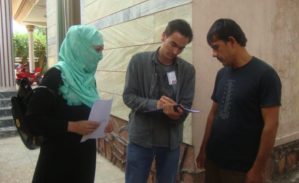
A party organizer practices voter canvassing through a door-to-door exercise. Photo credit: Munira Aziz, NDI Afghanistan

Cross-posted from NDI's DemWorks blog; written by Kate Cyr

“Data is what makes or breaks campaigns,” says Chris Doten, NDI’s senior manager for technology and innovation. “Knowing the voting population, what they like, don’t like, where you should be focusing your efforts -- that’s what drives how candidates and their staff interact with the community.”

Canvassing, an organized system of face-to-face citizen outreach, has long been used by politicians and advocacy groups to encourage constituents to vote, assess the habits and preferences of voters, and gather public opinion data. The time-honored tradition of knocking on doors remains an integral part of campaigns, though new mobile technology is starting to change the way canvassers operate on the ground.

Traditionally, field canvassers navigate constituent interviews with help from hefty question guides. The process can be difficult -- follow-up questions change based on an interviewee’s answer, and finding the right question may mean wasting time on awkward page-turning. Taking notes on constituents poses another problem, as canvassers may record things illegibly or in an incorrect shorthand.

For field organizers in advocacy and political campaigns, the logistics of sending canvassers into a community offer challenges as well. Canvassers may get lost, accidentally cover the same ground twice, slack off during a shift or falsify responses. Organizers have to devote time to creating routes, printing maps and logging canvassers’ data every day. READ MORE »

Contact Management in the Congo

Training Political Parties in the DRC


Last month, NDI trained political parties in the Democratic Republic of the Congo (DRC) on the use of CiviParty, NDI’s contact management DemTool, which is based on the open source contact relationship management (CRM) system, CiviCRM. READ MORE »

The Floor is Yours: A Q&A about Bosnia's New Issues Platform

We sat down (via Google Hangouts) with NDI’s Asja Kratovic, Resident Program Officer in Bosnia-Herzegovina (BiH), to discuss the recently released Imate Rijec website. Based on the Issues DemTool, the site brings together the voices of politicians and citizens on some of Bosnia’s most pressing social and political issues. Check out our Q&A with Asja below:

Q: What is Imate Rijec and how was the idea for the site first born?

A: Our inspiration for the site came from a desire to create an open space for two-way, direct communications between citizens and politicians in real time. That type of space is what Imate Rijec (which means “The Floor is Yours”) provides. Featuring video responses from more than 20 different politicians from nine political parties, as well as videos from citizens in three of the largest cities in Bosnia, the platform highlights the stances and positions of a wide variety of people on a series of relevant and popular political issues.

Other teams around NDI have pursued sites like this before, including the team in Belarus with their ePramova.org project. After speaking to the Belarusian team about their platform, we decided to move forward with a regional nonprofit called Dokukino to customize and develop NDItech’s The Issues DemTool to fit our needs.

READ MORE »

NDItech - Product Development Process

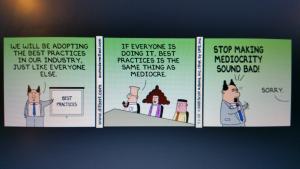
© Dilbert Project Management

This is the first in a series of posts on the NDItech team’s product development process. NDI’s tech products attempt to solve specific problems for people and organizations in emerging democracies. In this post, will look at the example of DemTools development to get an insight into our development process. More about DemTools can be found here.

For the last six months, our team has been following follow the scrum methodology, which is an agile software development framework, for the development and evolution of DemTools. Agile methodology allows us to be flexible, prioritize tasks, and respond to the evolving requirements of our customers.

We wanted to share a bit about how we’re using this agile methodology for developing tech-powered political change programs here at NDI. In this post we’ll tell you how we relate to people and programs, how we think about requirements, and the timelines for our sprints, and the tools we use to glue it all together.

Customers

For the purpose of development of DemTools, the primary customers are the country teams at NDI. The country teams in turn help political parties and civil society organizations in their respective countries use and benefit from NDI’s technology efforts, such as DemTools. READ MORE »

DemTools Launch - Our Storify

Meet DemTools: Closing the Geek Gap

DemTools: Open Source for Opening Politics

In the last few years, powerful, cloud-based web apps have revolutionized the way business, civic groups and governments engage with citizens. Online campaign management systems helped empower Barack Obama’s supporters to organize their communities on the way to victory; sophisticated customer relationship management (CRM) systems help businesses effectively push their wares; online communication platforms connect marketers with the populace.

Human rights and democracy advocates in the developing world have been left stranded in this leap to more effective tools. There’s a new form of digital divide that’s emerged: call it the geek gap. There are a lot of sophisticated open source software systems out there, but free software is a bit like a free puppy: the problem ain't the initial price, it’s the care and feeding over years. In low-infrastructure societies, there just aren’t a lot of people with the sophisticated systems administration skills to set up a Linux server, configure Apache, set up MySQL, and install a web application like Drupal. While there are great commercial options, struggling human rights organizations often can’t write the checks to keep those services running.

NDItech has been working on technology for development for over fifteen years, and we’ve seen the same problems manifest repeatedly. Sustainability in development is hard, and when it comes to tech it’s harder. Keeping the lights on - and web sites running - years after a project ends just doesn’t happen very often.

We're attempting to cut that Gordian knot with DemTools: the Democracy Toolkit. We’re launching with a set of four web apps that solve some of the most common problems our global network of partners have experienced. DemTools development was funded by a grant from the National Endowment for Democracy (NED). READ MORE »

Online Organizing Platforms

@SenWarren opens #RootsCamp13

Our last RootsCamp ‘13 round-up identified free tools to maximize voice, and to collect and analyze social and mobile data. Each tool was quite specific in its purpose and execution. Beyond these, the attendees (vendors and activists alike) discussed a broader set of platforms (suites) that attempt to manage people and data in a way that allow for a variety of campaign and advocacy activities including petitions, member engagement, mobilization, etc.  As before, find a round-up of the best-of-breed at the conference below. Send any of your own suggestions, and we'll update the list.

Campaign Management

NGP VAN is the largest provider of political data management tools for progressives in the US. With it’s recent purchase of NationalField, which builds tools for managing field staff and volunteers, they provide an integrated platform of fundraising, organizing, new media, and social networking products.

NationBuilder is billed as “Political campaign software starting at $19/mo”, NationBuilder has developed an impressive set of online tools for campaigns including websites, voter databases, fundraising tools, and communications tools. Nationbuilder is looking to internationalize its platform. READ MORE »

RootsCamp '13: Free Tools

Roots Camp Logo

Roots Camp 13 is over. This buzzy unconference of field organizers, digital directors, data geeks, and political wonks continues to be an intriguing amalgam of progressive activists growing skills, sharing knowledge, and building networks.

Many fascinating conversations tackled proactive and reactive messaging, mobile advocacy, testing and analytics, data-driven politicking, among others. The tweet stream and archive can be found at #roots13, and here's an initial review by David Weigel on Slate.

Striking the fancy of our @nditech team were the plethora of free online organizing tools that were highlighted throughout the sessions. I’ve posted a round-up of the best-of-breed below. Send any of your own suggestions, and we'll update the list.

Maximizing Your Voice (Message Distribution) READ MORE »

Voto Mobile - Engaging and Polling Citizens with the Power of Voice

Voto - Mobile Engagement, Simplified

There is an election in a week,  you want to poll the citizenry before the election, and your financial resources are limited. What should you do? Should you (A.) Give up because it is simply not possible to get a full-fledged poll out in the field. (B.) Beg your donor to give you a last minute cash infusion to bring on more staff and a polling company. (C.) Join the 21st Century and leverage technology to generate a fully randomized national telephone poll using a platform like Voto Mobile. Voto Mobile's goal is to make interacting with an audience via mobile phones - either one-way via broadcast or two-way in an interactive fashion -- easy and inexpensive.

Over the last few weeks I have had the opportunity to sit down twice with developers and staff from the socially conscious start-up Voto Mobile. Based out of Kumasi, Ghana, Voto Mobile has the straight-forward goal of “Mobile Engagement, Simplified.” The company is leveraging the ubiquity of mobile phones around the world to enable both research and social engagement that offers CSOs, NGOs, Political Parties and other organizations new capabilities. READ MORE »

ElecTech Afghanistan: Increasing Transparency and Participation

MTN welcomes visitors to Kabul International Airport

I’m recently back from Electech Afghanistan, an NDI-hosted elections and technology conference in Kabul. The event brought together senior officials from government, civil society, the private sector, and the international community to discuss applications of digital technologies to enhance transparency and participation in the election process.

Ahead of the Presidential elections in April 2014, the Afghan public lacks confidence in the government’s ability to run a credible election and this is diminishing participation and prospects for stability and democratic development. Afganistan is, of course, a supremely insecure environment with low rates of literacy throughout the population.

Participants identified ways that technology could improve participation and confidence by helping election authorities in administration, improving how political parties compete, increasing citizen’s participation, and enabling civil society organizations to observe more effectively, all while allowing journalists such as Pajhwok News to publicly share results and analysis. Discussion focused on the changing nature of political participation mediated by technology.

From Broadcast to Mobile and Social READ MORE »

The Georgian Elections: Popular Perceptions of Leaders and Parties

Georgia

In Georgia, presidential elections are set to take place this October, generating new interest in the country’s changing political landscape.  NDItech has been engaged with our local partners in using tech to systematically monitor the election there. This will be the sixth presidential election in the country since the country’s declaration of independence from the Soviet Union in 1991, and comes at a key time in the nation’s politics.  The elections will take place one year after President Mikheil Saakashvili’s United National Movement (UNM) party was defeated in the parliamentary elections by the Georgian Dream party led by Bidzina Ivanishvili, who became the new prime minister.  This defeat represented a significant blow to President Saakashvili, who led the country’s pro-Western Rose Revolution in 2003. A poll conducted by NDI provides some interesting insights into the nature of political opinions among Georgians. NDI conducts public opinion polling in numerous countries on political issues as part of our work. READ MORE »

Innovation in Context

Innovation comes in many forms. And you sure hear it a lot.

Given my instinctive cringe whenever I hear the term "innovation" these days, the word may a wee bit overused. However, it the concept remains as important as ever - if organizations aren't trying new things, they're stagnating.

As a global organization working with partners in a lot of different country contexts, though, I sometimes have to check myself and remember that innovation lives in local contexts. NDI's supported scores of sophisticated election monitoring missions across the world using the Partial Vote Tabulation system, including most recently in Kenya. The methodology's a tried and true one - I'll write it up soon - and has been used for over a decade. From a global perspective, it ain't new.

In Tunisia, however, it's a massive step. (No, not this kind of step.)

Given their shiny new democracy and the fact they've only had one real fair election in generations, any form of election monitoring is new. Moving to one that requires thousands of citizens across the country to work in concert with an extraordinary degree of accuracy is a big deal. READ MORE »

Tech Innovation for Democracy (and FTW!)

Ghana elections 2008 sms

I am excited to announce that I am joining NDI to work on tech innovations.  NDI is a leader in using tech for building democratic people and institutions, and an organization that I have known of and worked with ever since I started MobileActive.org (way back in 2005). In fact, my now-boss Chris Spence was part of the inaugural meeting that we convened on 'mobile tech in social change' in 2005 that eventually led to NDI being the undisputed expert organization in using SMS in systematic domestic election observation, work that I have written much about.  

I will be working with the pioneers at NDItech, and the creative program staff in the NDI offices that are using tech in innovative ways to support representative democracy in areas such as citizen participation, elections, open parliaments, strong parties, and accountable and transparent institutions.  Democracy and governance, as the field is affectionately known by those inside it, is where I started more than 20 years ago, and I am thrilled to return to it, throwing into the mix creative uses of online technologies, new media, and mobile (of course).  And while 'innovation' is a much-(over)used term these days, I'm hoping to put our own imprint and interpretation on it as a part of the growing #tech4dem field.

READ MORE »

Are you listening? Consultation in Policy Development

Pirate Party - Direct Democracy, with style

Earlier this month I had the opportunity to work with Social Democratic party members from around Southern and Eastern Europe (Croatia, Serbia, Albania, Macedonia) as part of a conference coordinated by NDI’s Regional Party initiative (RPI) and the ruling party in Montenegro, Demokratska Partija Socijalista. Thematically, the conference focused on ICT and political participation through sessions on transparency and accountability, campaigning, youth leadership and policy development.

The latter, policy development, is central to the conference series, and we discussed ways that smart applications of technology can improve the outcomes of policy development.

As we’ve witnessed in the last few years, the “internet public” reflects the changed nature of human beings as social and civic individuals.  As part of this phenomenon, new connections are increasingly important, and pertinent information gets shared rapidly. One driver of these tools for political use has been the perception that political bodies are self-interested, dysfunctional, and don’t represent citizen interests. We’ve seen citizens rebelling against this order in ongoing Arab Spring uprisings, the Occupy Movement, and newly founded political parties and organizations. READ MORE »

NDItech is Hiring: Data for Democracy in Eurasia

Now Hiring. Enquire Within.

Skilled political organizer used to wrangling data? Russian speaker? Got tech? We're hiring.

The NDItech team is looking for someone to run a critical project in Eastern Europe for a period of approximately three months. The job: teaming with activist organizations who are learning to use online datastores and CRM systems to manage their information to win elections. They're savvy campaigners and used to tech, but the cloud will be new to them and comes with significant risks.

In addition to teaching how to take advantage of such systems safely you'll be helping these groups design field plans, advising on communications strategies and assisting with setting up training programs. Language skills are critical to ensure the ability to work side by side with our partners in these highly motivated activism and advocacy groups.

As our boots-on-the-ground operating out of an NDI field office you will have significant project input while being be supported by an expert team of tech, advocacy, and communications professionals. This is an excellent gig for a data and organizing ninja/rockstar/guru. You must be highly mobile, competent, and self-directed.

Check out the details then send any questions and your applications to [email protected]

Tuit-Tuit: Mexican Party Holds Twitter Contest To Improve Governance

The #LogrosPAN hashtag

This is a guest post from Julian Quibell, NDI’s resident senior program manager in Mexico. You can meet Julian on Twitter or Facebook.

Mexican political parties have increasingly used communication and information technologies (ICTs) -- particularly social networks like Facebook and Twitter -- as a low cost means to broadcast information to their members and the broader public. Our team here at NDI in Mexico has been working with all major political parties, in government and the opposition, to adopt new practices that harness the power of these tools not only to inform, but also to consult and mobilize around their causes.

An excellent example of these innovative uses of ICTs can be found in a recent online competition put on by the Outreach Secretariat of the National Action Party (PAN). Born of an idea shared by our team at NDI, the PAN designed an online competition that increased the number of users (followers, fans) on the party's various social media accounts, transmitted thousands of positive messages about PAN achievements over the last decade, and provided the party a broad base of feedback on different issues of public concern (education, the economy, public security, etc.). READ MORE »

Data Envy

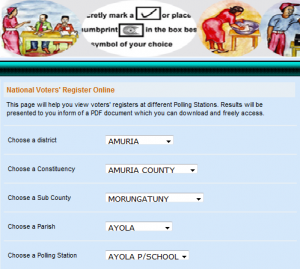
National Voters' Register Online

The Uganda Election Commission recently launched their National Voters' Register Online system - with the assistance of our friends over at IFES - that allows citizens to confirm that their name appears on the voters roll in their polling place . This is a great step and important service - and something we don't see often enough in many countries around the world. IFES and the other international organizations should continue to focus on these kind of technology initiatives around election administration - and then take the next step by helping civil society groups and political parties use the data to hold electoral officials and governments accountable for good elections.

The data available through the Uganda tool allows citizens to look themselves up if they know where they are registered to vote, and voter lists are provided for each of thousands of polling centers. There are limits to what can be done with data in this format - but the system knows who is registered to vote where, and thus where polling stations are and how they map to all the political districts in the country. The election officials may also have geocode information for polling centers and map data. READ MORE »

Syndicate content